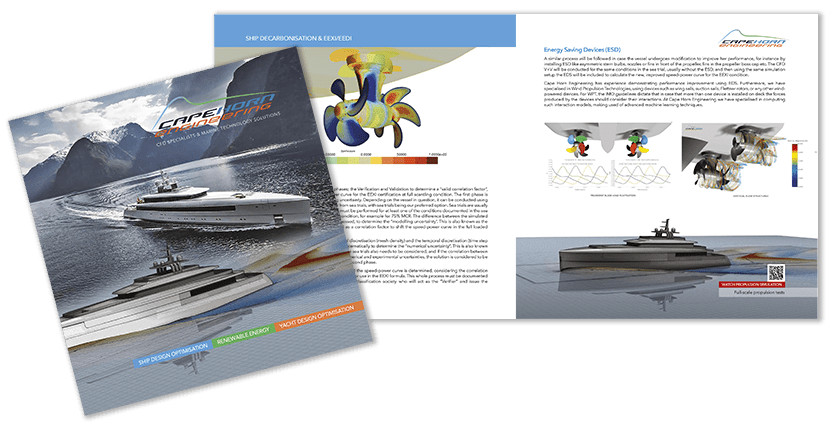
Carbon Free Propulsion Alternatives and Design Solutions
Cape Horn Engineering has pioneered RANSE-based CFD since its very beginning, with continuous investment in research and development. Our specialist ship decarbonisation CFD technology and expertise is at the forefront of new design solutions to enhance energy efficiency in the shipping industry. To help reduce emissions, we assist shipping companies with our specialist ship decarbonisation CFD services to investigate carbon free propulsion alternatives.
We also specialise in EEXI / EEDI calculations based on high fidelity RANS CFD, and we offer EEXI / EEDI calculations in a very efficient and cost effective manner. We have developed validated workflows and Best Practice Guidelines in conjunction with a leading classification society (Lloyd’s Register), including the testing of potential solutions for real vessels.
Cape Horn Engineering is proud to provide a range of services to clients across the shipping industry. In addition to standard performance analysis, design optimisation, and seakeeping analysis, Cape Horn Engineering offers a range of services that can be tailored to your specific needs. In recent years, the increased demand of the industry has led to us gaining extensive experience in:
- EEXI calculations
- Analysis of ESD’s
- Comparison and development of WASP Devices
Energy Efficiency Existing Ship Index (EEXI)
CFD offers a cost effective and fast solution to develop speed-power curves for vessels lacking data that meets the strict conditional requirements of the regulations. Cape Horn Engineering is experienced in calculating the reference speed of a vessel for EEXI, having developed an efficient workflow in conjunction with a leading classification society.
Employing CFD ensures the calculated reference speed accounts for the physical flow around the vessel, considering any modifications or ESD’s that have been installed, while avoiding the time and expense of model testing. CFD is considerably more accurate than the conservative empirical formulae supplied by the IMO, and this higher fidelity calculation can help secure compliance for marginal vessels. Our CFD technology can be used to enhance the energy efficiency through three primary mechanisms:
Design exploration and optimisation using a simulation driven approach
Our workflow is heavily automated, therefore reducing analysis time significantly. We can run hundreds of calm water simulations per day, and as CFD allows for rapid geometry changes, multiple design candidates can be evaluated in a short time frame. At its lowest level, this makes it very fast to compare multiple prospective designs. Based upon the CFD results, changes can be manually implemented by the naval architects and the updated design can be quickly evaluated. It is also possible to focus on a single feature of the vessel, for example, quantifying the performance gains from a bulbous bow and then comparing it against several bulb designs. At its highest level, this allows fully automated optimisations to take place. The CFD simulation can be paired with an optimisation algorithm and a parametric model in an automated loop, allowing us to effectively explore the entire design space.
Investigation of novel ideas and technologies implemented in a short time frame
Utilising our CFD technology removes the constraints of traditional model testing. By analysing the model in full scale, elaborate test rigs do not need to be devised and complicated scaling issues are no longer an issue. The post processing capabilities of CFD are immense. Forces can be decomposed into the shear and pressure components, and quantified for the different surfaces. Pressure fields can be plotted and visualisation techniques such as streamlines can be utilised, allowing for a far more detailed understanding of the flow field. Interactive visualisation scenes allow the user to explore the solution, viewing it from any perspective. Together, these tools form an environment in which new ideas can be tested, examined, and thoroughly understood so that they may be exploited to their full potential.
A holistic, integrated design process
Ship design traditionally follows a design spiral approach, which is functional and logical yet can be restrictive and inefficient. It is made up of several steps, involving different teams, each using different tools and data sets. Modern tools such as CFD, FEA and 1D system simulation software may be incorporated into this workflow to offer improvements, but the full potential of these tools is unlocked when used to facilitate a move to an integrated digital approach. Bringing all the design processes into one single, centralised environment improves project efficiency and collaboration, while driving innovation. This digital twin methodology can enhance a vessels energy efficiency by facilitating a multi-domain design space exploration.


Validation & Verification (V&V)
Cape Horn Engineering have simulation workflows and analysis tools to efficiently perform verification and validation (V&V) of a simulation set up, in accordance with ITTC Quality Control Procedures. The process of V&V is integral to producing reliable and accurate CFD results and is something that we have always taken very seriously. These V&V procedures ensure that our CFD results meet the strict requirements of the IMO when performing EEXI simulations.
Energy Saving Devices (ESD)
Energy Saving Devices offer great potential to improve a ship’s efficiency, reducing both the emissions and operational expenses. They may also be employed to help a vessel meet EEXI requirements.
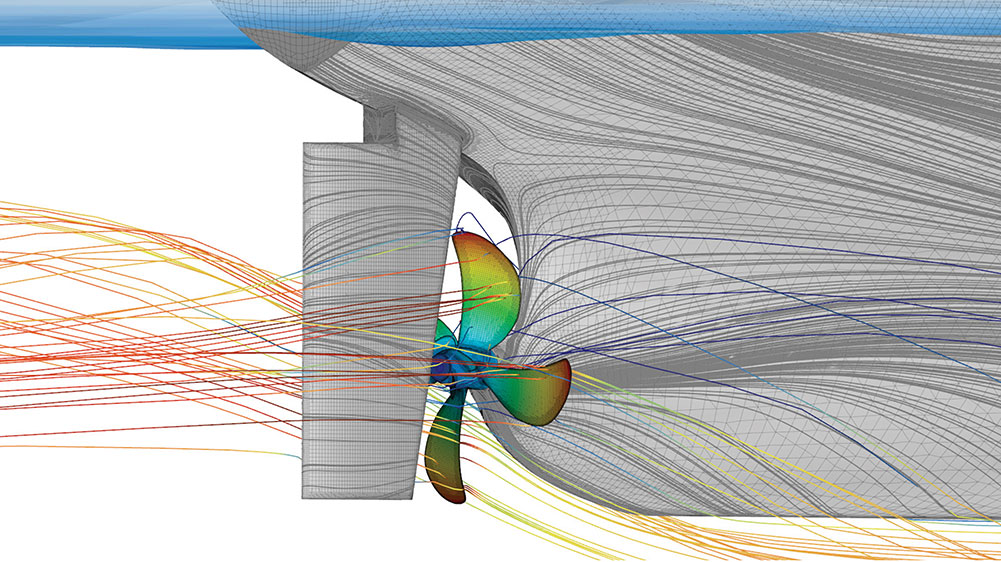
CFD provides the perfect test environment in which to model ESDs at full scale, as applied to the physical ship geometry. We are experienced in complex simulation set ups such as those in which propulsion is modelled with a rotating, meshed propeller geometry, as opposed to relying upon common simplifications, thus ensuring the highest degree of accuracy. This analysis confirms the ESD will perform as expected, and that maximum efficiency gains are achieved prior to the costs of installation. Below is a EEXI simulation demonstrator.
CFD advantages compared to tank testing
- All simulations are at full scale
- Simulations use realistic inertias and centres of gravity (something not feasible in tank testing)
- Oblique incident waves coming from any direction can be simulated, tank testing is usually limited to head waves
- Decomposition of individual forces and moments for the hull and each appendage
- Precise analysis of motion velocities, accelerations and trajectories of the body
- Flow can be visualised and animated, giving clear insight and understanding into the differences between designs
- Simulations are 100% reproducible
- Hull or appendage shapes can be easily changed without building new models
- Quickly test many design configurations, such as swapping appendages
- Rapidly evaluate performance in a variety of sailing conditions (speed, wave characteristics etc.)
- Time and cost reduction


Ship Design Optimisation
Cape Horn Engineering has pioneered RANSE based CFD since its very beginning and continues its research work on a daily basis. With our proven track record in yacht racing design, we can apply this cutting edge technology to a variety of marine vessels including commercial ships, cargo ships, service operation vessels and work boats, to enhance energy efficiency, improve performance, comfort and safety, reduce emissions and save on fuel.


Wind Propulsion Technology (WPT)
To address the global challenge of reducing emissions for commercial shipping, operators are turning to carbon-free propulsion alternatives, with the introduction of WPT (Wind Propulsion Technology) emerging as a viable solution. Due to our renowned experience and specialist technology, we are able to offer a holistic analysis of the benefits of WPT and have developed a simulation workflow to directly compare the efficiency of wind assisted ship propulsion (WASP) devices.


Case Studies
See our case studies on Ship Design Optimisation & Decarbonisation
Simulations
Self-propulsion CFD simulation for the award-winning superyacht Najiba, with rotating propellers at a constant RPMto calculate the vessel speed and shaft power. The yacht is modeled in detail, with all appendages including roll sabiliser fins included.
Examples of CFD simulations carried out for motor yachts and commercial ships. Resistance, propulsion, seakeeping, slamming, exhaust gas on deck.
Demonstration for a 4 Degrees-of-Freedom simulation, with freedom for the yacht to move naturally though the waves. The open-water propulsion is based on the yacht propeller. The propeller torque is kept constant, and thrust and delivered power are variable.
Cape Horn Engineering has developed a simulation workflow to directly compare the efficiency of wind assisted propulsion (WASP) devices.
CFD simulations and analysis of solid wings. A new sail power concept designed by Windship Technology to reduce emissions for commercial shipping.
Turning Circle Manoeuvre of a 50m superyacht following the ITTC Recommended Procedure for Full Scale Manoeuvre Trials. 6 DOF simulation with active rudders and fin stabilisers.
We are members of ZESTAs and International Windship Association.